THE SILENT ZERO: AUDITING A REGULATED UTILITY'S TARIFF MODEL INTO A LENDER-GRADE CREDIT TOOL
- Problem
- POWERGRID's finance team needed CERC's 2024 tariff regulations turned into a model that computes the Annual Fixed Charge correctly and lets them test assumptions without re-deriving the math.
- Audience
- The utility's finance team and, downstream, lenders assessing the project.
- My role
- Summer Intern, Finance & Regulatory Affairs
- Timeline
- Apr–May 2026
- Key decision
- Left externally filed petition figures and ambiguous combined inputs hard-coded on purpose, rather than rewriting numbers without source documents.
- Solution
- An integrated, driver-based model with one named parameter block for every regulatory constant, plus a DSCR/credit view for lenders.
- Outcome
- Circular reference that silently zeroed ROE outside Excel: found and fixed before handoff
- 102 spilling-XLOOKUP cells rewritten so the model opens correctly in any engine
- Min DSCR 1.49x vs a typical 1.20x lender covenant
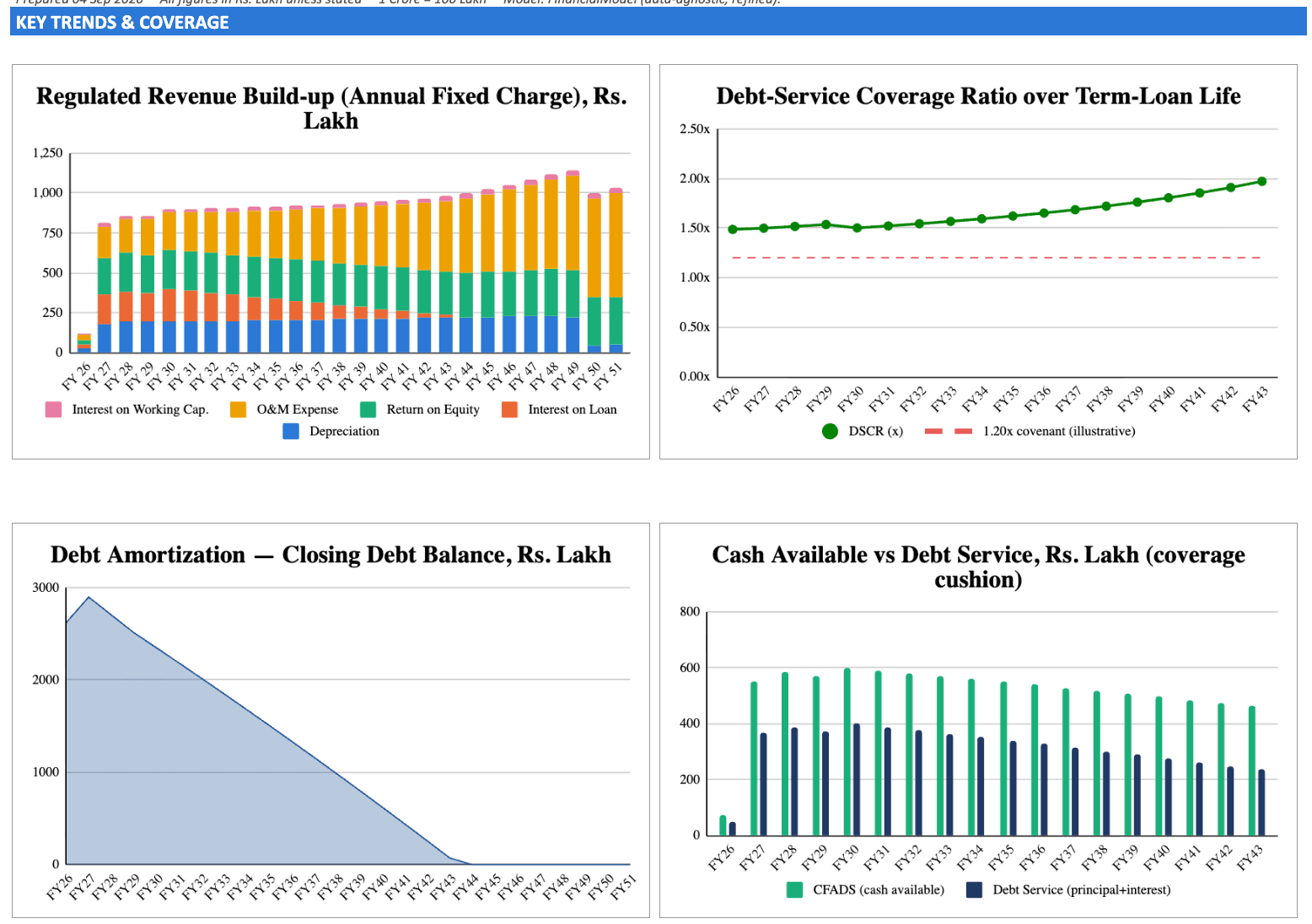
A transmission utility doesn't earn revenue by selling into a market — it recovers a tariff set by the Central Electricity Regulatory Commission (CERC), computed as an Annual Fixed Charge (AFC) built from depreciation, interest, return on equity and O&M. The asset in question was a single transmission augmentation project with a ~25-year regulated life and a capital cost north of ₹24 Crore. The brief was to turn CERC's Tariff Regulations, 2024 into a working model: one that could compute AFC correctly, forecast the full financial statement set, and let the finance team test assumptions without re-deriving the math each time a number changed.
Mapping the Regulatory Forms
The first phase was mechanical but unforgiving: mapping each CERC schedule (Form 8 for Return on Equity, Form 9C for Weighted Average Rate of Return on Investment, Form 10 and 10A for depreciation, Form 11 for Interest on Working Capital, Form 9E for Interest on Loan, Form 2 for O&M, and Form I for the tariff summary) against the project's actual cost sheets, tariff orders and auditor certificates, then wiring all of it into linked Depreciation, Financing, ROE and Working Capital schedules that feed a single AFC number — which in turn drives an integrated P&L, Balance Sheet and Cash Flow, each carrying its own validation checks so the statements had to balance, not just compute.
The Silent Zero
The more interesting work started after the model looked done. A full audit pass turned up a two-cell circular reference between the Return on Equity form and the assumptions sheet — each pointed at the other with no anchor. In Excel this is invisible: Excel's iterative calculation quietly reuses the last cached value, so the workbook keeps showing a plausible number forever. Opened fresh in a different calculation engine — no cache to fall back on — that loop resolves to zero, which cascades into a wrong Return on Equity, a wrong AFC, and wrong totals in the tariff summary. It only surfaces the moment someone recalculates the file from scratch, which is exactly what happens when a model changes hands. The fix was to anchor the Return on Equity form to its flat, already-correct base rate instead of a loop with no floor — a one-line change, but the kind that's invisible until it silently breaks someone else's numbers.
A Portability Problem Hiding in Plain Sight
The same audit found a portability problem hiding in plain sight: 102 cells across three sheets used XLOOKUP as an implicit spilling array formula. Spilling XLOOKUP isn't supported by every engine that opens an .xlsx file — LibreOffice and some older Excel builds choke on it — so the model worked perfectly on the machine that built it and produced silent #NAME errors on anyone else's. Every instance was rewritten as an equivalent per-cell INDEX/MATCH — same lookup, same result, no spill dependency — along with removing a dangling external-workbook link that had been silently pulling a label from a file that only existed on one machine.
One Source of Truth
The deeper fix was structural: CERC's regulatory and tax constants — the 70:30 debt-equity gearing, the 15% IOWC O&M norm, the depreciation averaging factor, the MAT rate and its surcharge and cess multipliers — were typed inline inside formulas across half a dozen sheets, in some cases as duplicate hardcoded figures entered independently in two places. That's fine for a one-off calculation and unauditable for anything else: nobody could look at the workbook and see what CERC actually assumes versus what this specific project assumes, and two copies of the same number can drift. Every one of those constants was pulled into a single labeled, named-range parameter block, and every formula that used to have the number typed in now reads from that block instead — one source of truth, visible and editable without touching a formula.
Knowing What Not to Fix
Not everything got 'fixed,' and that distinction mattered as much as the fixes themselves. A handful of input cells combine two or three project-specific cost figures in one formula; splitting them into labeled components would have meant guessing which cost certificate each number came from without the source documents to check — so they were left as project inputs with a comment recording the original formula instead of a plausible-looking rewrite. Similarly, the 'AFC as per Petition' row in the tariff summary stayed hardcoded on purpose: those are externally filed figures, used deliberately as a reconciliation check against what the model computes, not something the model should be allowed to overwrite. Knowing which numbers to leave alone was as much a part of the audit as knowing which ones to fix.
From Compliance Calculation to Credit Tool
With the model verified and portable, the last phase reframed it entirely: from a compliance calculation into something a lender could actually read. An Executive Summary one-pager surfaces the capital structure, regulated return, and coverage ratios up front; a full annual DSCR and interest-coverage build sits underneath it; and a sensitivity layer stress-tests five levers — interest rate, availability, depreciation method, O&M escalation and additional capitalisation — against Base, Growth, Stress and Conservative scenarios. The sensitivity run surfaced a genuinely useful insight: O&M escalation and capex scale turned out to be DSCR-neutral, because in a cost-plus regulatory regime those costs pass straight through to the tariff — the coverage ratio only moves on financing assumptions (interest rate, availability, depreciation timing), which is exactly the kind of thing a lender needs to know before pricing risk, and exactly the kind of thing that's easy to miss if you only look at the AFC total.
Verification Discipline
Every change — the circular reference fix, the 102 formula rewrites, the constant extraction — was checked the same way: recalculate the full model end-to-end, then compare the computed AFC and the reconciliation difference against the petition figures, before and after, to the decimal. Zero formula errors was the target, and every simplification the model still makes (blended vs. per-asset-class depreciation, a flat effective tax rate, a single blended interest rate) is written into an Assumptions Register that states what it simplifies, what it costs in accuracy, and exactly which lever to pull to refine it. The point wasn't to make the model look more sophisticated — it was to make every assumption visible enough that someone else could disagree with it.
KEY OUTCOMES & DELIVERABLES
- Diagnosed a two-cell circular reference between the Return on Equity and assumptions schedules that resolved to zero under a fresh recalculation — invisible in Excel's cached iterative mode, fatal in any other engine — and anchored it to a stable base rate.
- Replaced 102 cells of spilling XLOOKUP formulas across 3 sheets with equivalent INDEX/MATCH formulas after confirming the spill pattern silently broke in LibreOffice and older Excel builds.
- Extracted every hardcoded CERC regulatory and tax constant (debt:equity gearing, IOWC O&M norm, depreciation factor, MAT rate/surcharge/cess) into one labeled, named-range parameter block, removing duplicate hardcodes entered independently in multiple sheets.
- Verified every fix end-to-end: recalculated the full model and compared computed AFC against the pre-change baseline and the externally filed petition figures to the decimal, targeting zero formula errors.
- Deliberately left project-specific combined-cost inputs and the externally filed 'AFC as per Petition' reconciliation row untouched, flagging them with comments rather than guessing a split without source documents.
- Layered a lender-facing credit assessment on top of the compliance model: an Executive Summary one-pager, full annual DSCR/interest-coverage build, and 5-lever sensitivity analysis across 4 scenarios (Base, Growth, Stress, Conservative).
- Found that O&M escalation and capex scale are DSCR-neutral under the cost-plus tariff regime — coverage only moves on financing assumptions — and documented every remaining model simplification, its impact, and its refinement lever in an Assumptions Register.