THE DIRECTORY BROKERS DIDN'T WANT: BUILDING TRANSPARENT PRICING INTO A COMMISSION-DRIVEN MARKET
- Problem
- Students arriving in Katwaria Sarai (50,000+ in 0.69 sq km) could only find PGs, tiffin and libraries through brokers who kept prices deliberately opaque.
- Audience
- Students, UPSC/GATE aspirants and young professionals relocating near IIT Delhi and JNU — and the local merchants serving them.
- My role
- Group 1, Section A — with Abhishek Singh Panwar, Vidhi Jain, Vidhi Dhanuka, Sanbarta Bandopadhyay
- Key decision
- Made published, verified pricing the product's edge over brokers, and ran merchant onboarding over WhatsApp so supply could grow alongside demand.
- Solution
- A live Next.js + Sanity directory across 7 service categories, plus a ₹60,000/year acquisition campaign.
- Outcome
- 200+ PG listings mapped; real rents (₹4,500–₹15,000/month) sourced from 8+ owner interviews
- 6-month targets set, not claimed: <₹150 cost per lead, 400+ verified leads/month
- Links
- Live site ↗
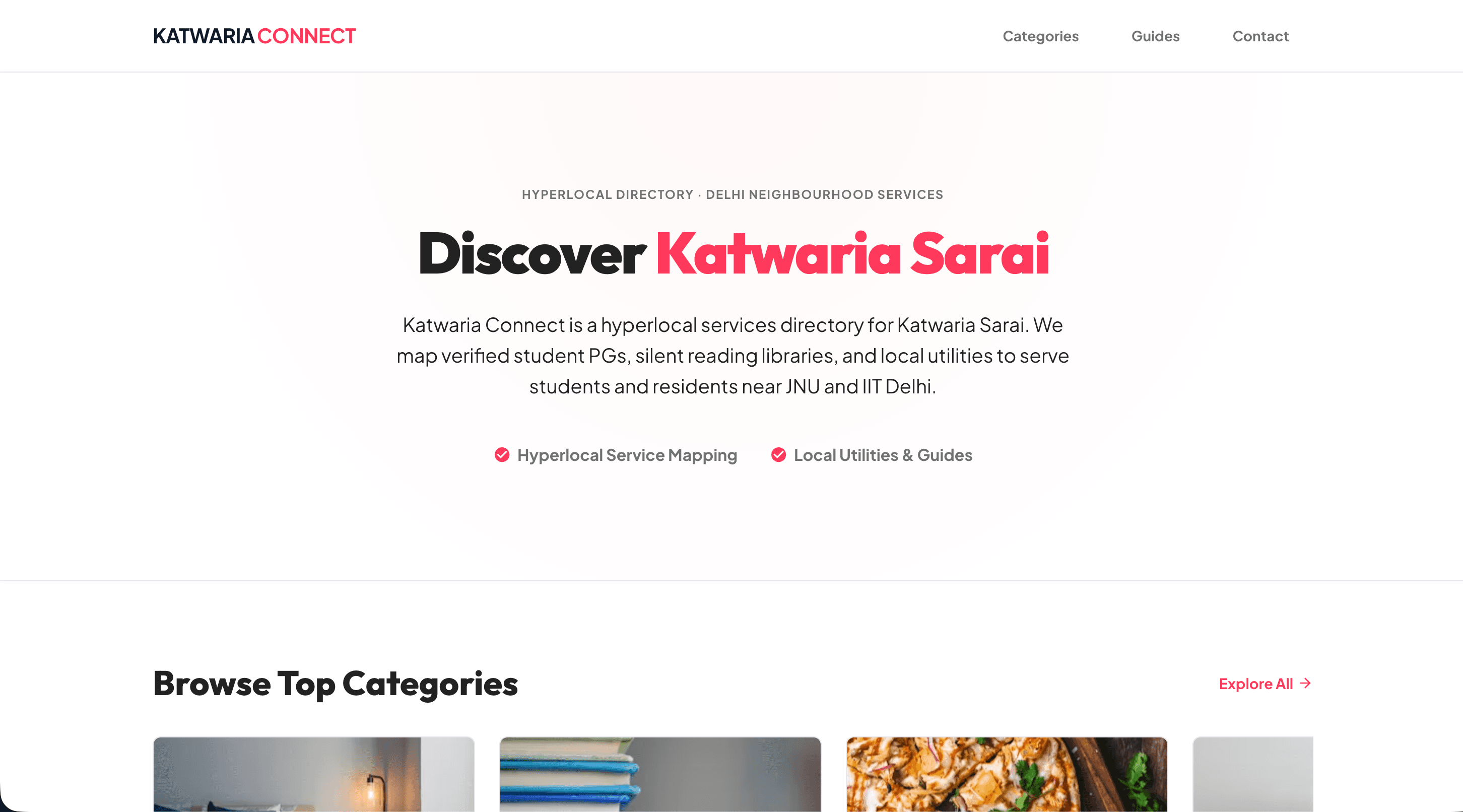
Katwaria Sarai is a dense student micro-market in South Delhi — bordered by IIT Delhi, JNU and the Qutub Institutional Area — with an estimated 50,000+ students, UPSC/GATE aspirants and young professionals packed into a 0.69 sq km catchment. Every service a new arrival needs (PG accommodation, reading rooms, tiffin, laundry) already exists there in volume. None of it had a structured digital presence: discovery ran entirely through brokers and word-of-mouth, and PG pricing was deliberately obscured to protect broker commissions. Katwaria Connect is a live, deployed directory built to fix that, plus the funded acquisition campaign designed to actually get it in front of the students who need it.
Verifying the Market Before Building for It
The research wasn't a desk exercise. It included walking the neighborhood's key blocks to catalogue business density firsthand, direct interviews with 8+ PG owners and 4 library operators to get real pricing rather than advertised pricing, cross-verification against 99acres and NoBroker listings, and mining Reddit communities (r/UPSC, r/JEEPreparation) for the actual language students use when describing what they're looking for. That grounding produced concrete, sourced numbers: PG rates from ₹4,500 to ₹15,000/month depending on sharing and amenities, tiffin subscriptions at ₹2,200–₹2,800/month, and library seats at roughly ₹1,200/month for a 12-hour shift — numbers the directory could publish transparently in a market where transparency itself was the product's edge over brokers.
Built for Speed and Search, Not Just for Launch
The site runs on Next.js and Sanity CMS on Vercel, with 7 category directories from accommodation to transport, built for static generation and incremental regeneration rather than a slower client-rendered stack. On-page SEO was treated as a first-class deliverable rather than an afterthought: unique meta titles and descriptions per page, a strict heading hierarchy, and a verified 22-URL sitemap — because the entire acquisition thesis depends on capturing a specific, low-competition keyword pattern (a hyper-local place name paired with high-intent service terms like "PG" or "library") that generic city-wide competitors like Sulekha and Justdial don't optimize for at this granularity.
A Campaign Designed Around One Constraint: ₹60,000 a Year
The Part 2 campaign strategy treats that budget as a genuine constraint to be allocated deliberately, not a number to justify after the fact. 40% goes to Google Ads, aimed specifically at bottom-funnel, transactional searches like "PG near IIT Delhi" — the moment of highest intent, with match-type strategy (phrase and exact prioritized, broad capped at 15% spend) built to keep cost-per-click down without sacrificing the ability to discover new query patterns. 30% goes to Meta Ads, deliberately positioned earlier in the funnel — reaching students before they start actively searching, with creative built around trust cues ("Verified," "zero commission") rather than price, because the target audience was explicitly briefed as "first-time relocators, anxious about broker scams," not price-shoppers. The remaining 30% splits between organic content, which compounds at near-zero marginal cost, and a specific B2B line for merchant acquisition — because a directory's supply side has to grow at the same time as its demand side, or the directory becomes stale.
The B2B Loop Nobody Asked For, But Every Directory Needs
The most structurally important design decision doesn't show up as a single line item: WhatsApp-first merchant onboarding, where a merchant sends photos and pricing directly over WhatsApp, the team verifies within 24 hours against a listed standard, and the listing goes live through the same Sanity CMS the content team already uses. Every field visit, every QR standee, every boosted "List Your Business" post feeds that same loop instead of creating a separate, harder-to-maintain merchant pipeline — a directory with active student demand and no merchant supply growth just becomes an increasingly outdated brochure.
Honest About What's Unproven
The Google Ads plan for merchant acquisition specifically flags its own volume estimate as "not a verified claim, treated as a small supporting spend" — a level of honesty about an untested channel that's easy to skip in a pitch deck. Similarly, the plan holds off on Meta's Lookalike targeting because the current merchant contact list (8+) sits well below the roughly 100-contact minimum Meta needs for a reliable Lookalike audience, and says so directly rather than running a Lookalike campaign on a sample too small to be meaningful. The overall 6-month KPI targets — 8,000+ monthly sessions, 400+ verified leads/month, a blended cost-per-lead under ₹150, 20+ new merchant listings a month — are stated as targets to be measured against, not outcomes already assumed.
KEY OUTCOMES & DELIVERABLES
- Verified real market pricing (PG ₹4,500–15,000/mo, tiffin ₹2,200–2,800/mo, libraries ~₹1,200/mo) through 8+ merchant interviews and cross-checks against 99acres, NoBroker and Google Maps reviews.
- Shipped a live Next.js + Sanity CMS site with 7 category directories, built for SSG/ISR speed and a 22-URL sitemap targeting low-competition, hyper-local long-tail search terms.
- Allocated a ₹60,000/year campaign budget across Google Ads (40%), Meta Ads (30%) and organic + B2B merchant acquisition (30%), matched to funnel stage rather than split evenly.
- Designed a WhatsApp-first merchant onboarding loop (photos + pricing → 24hr verification → live CMS listing) so every acquisition touchpoint feeds supply growth, not just demand.
- Explicitly flagged unverified assumptions rather than presenting them as fact — including holding off on Meta Lookalike targeting because the merchant contact list is below Meta's reliable-audience minimum.