SAME QUERY. TWO APPS. TWO COMPLETELY DIFFERENT ANSWERS.
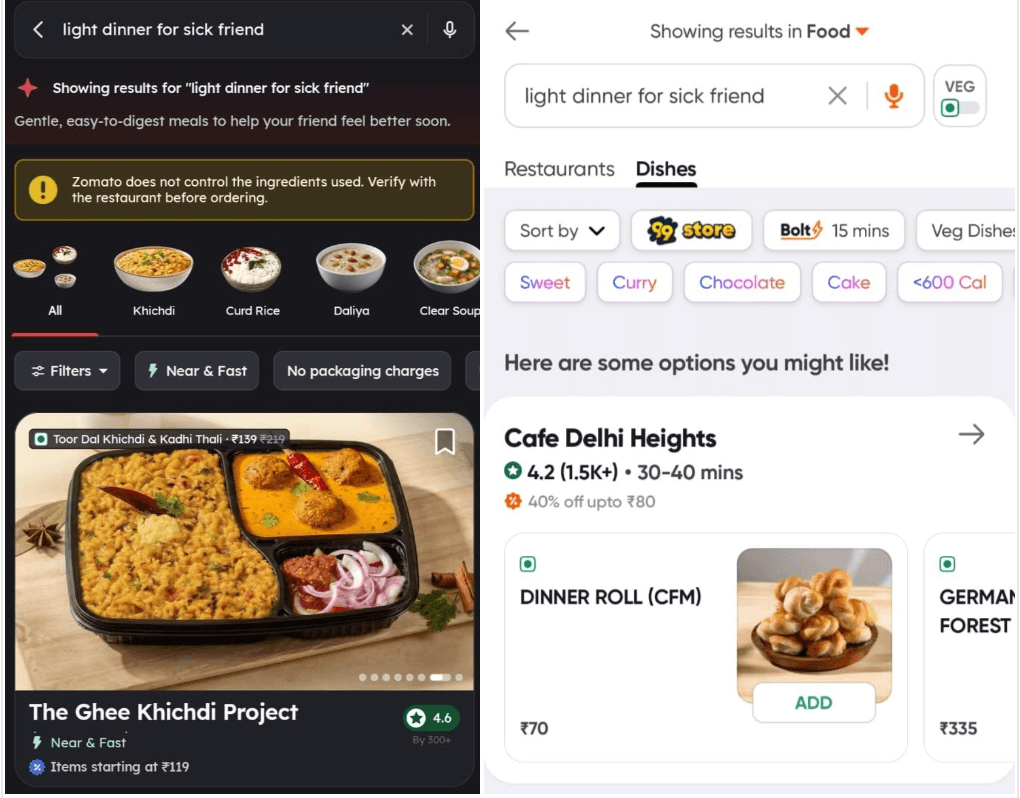
Same query, two apps, two completely different answers. I searched "light dinner for a sick friend" on Zomato and Swiggy within minutes of each other.
Same Words, Different Understanding
Zomato returned khichdi, daliya, and clear soup, with an explicit note attached to the results: "Gentle, easy-to-digest meals to help your friend feel better soon." Swiggy returned dinner rolls, German forest cake, and ice cream — technically dinner items, but nothing about them reads as "light" or "for someone unwell." Same eight words typed into two search bars, and one system clearly understood the intent behind them while the other matched on food-adjacent keywords and stopped there.
There's No Ingredient Called Empathy
The real question is how a model understands "sick friend" at all — there's no ingredient tagged empathy, no column in a menu database for emotional context. Are AI models pre-trained for these kinds of open-ended, situational queries? Yes and no. Yes, to some extent, through human labelers who teach a model what a good answer looks like for common patterns. No, not for every context, every constraint, every way a user might phrase a specific situation — which is exactly the gap that shows up as "dinner rolls and cake" for a sick friend.
Turning Vague Intent Into Checkable Facets
This is where the real product work happens, and it happens before the model ever sees the query. The query gets dissected into facets — small, binary, answerable checks that turn a vague intent into something a system can actually evaluate: is the meal light? is it easy to digest? is it appropriate for someone who's unwell? The model isn't guessing at "sick friend" as a vibe. It's checking the candidate results against a defined list of facets that someone had to write down, test, and agree on, long before a user ever typed the query.
Facets Are Never Defined Once
And that list isn't static. Facets get tested, argued over, and revised over time — what reads as obviously "light" to one person on the team isn't obvious to another person, or to a model trained on a different distribution of past queries than the one it's being asked to generalize from now. Getting this right is iterative, not a one-time setup step.
What looks like a smart model, in a moment like this, is usually a series of very deliberate product decisions made long before the model was ever part of the conversation.
“What looks like a smart model is often a series of very deliberate product decisions made long before the model was involved.”