RIDERS CAN SEE THEIR PAYOUT. THEY CAN'T EXPLAIN IT.
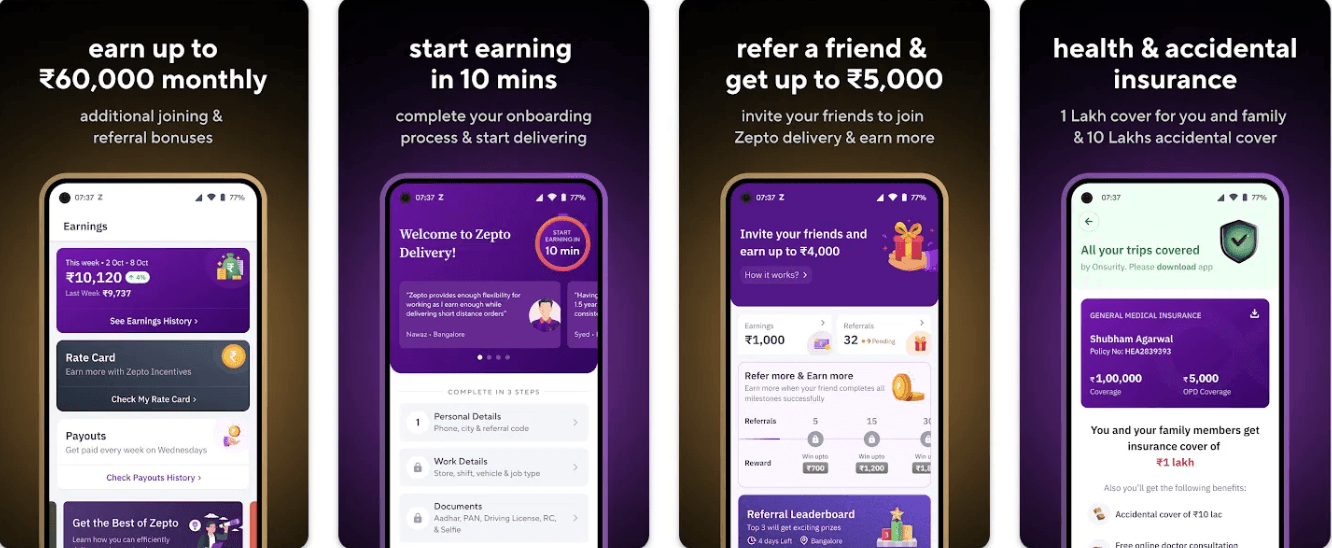
Zepto's own rider-recruitment listing promises “earn up to ₹60,000 monthly” and “weekly payments — full visibility of earnings, incentives & payouts.” I screened over 100 rider reviews of the delivery-partner app to check that promise against what riders actually report. The reviews say something more specific than “support is slow”: riders can see a number land in their account. They cannot explain how it was calculated. That's not a support gap. That's a broken piece of the recruitment promise itself.
What 100+ Rider Reviews Actually Show
The filter mattered as much as the reading. Reviews were sorted by Relevant and Recent rather than taking whatever the app store caches at the top, then narrowed to 1- and 2-star ratings — the ratings where a rider is angry enough to actually describe what went wrong instead of just leaving a star count. Each one was read for its proximate cause, not keyword-matched, and grouped from there.
That produced 55 classified reviews across six clusters: payout transparency at 24% (13 reviews), app/UX at 22% (12), support at 16% (9), onboarding at 15% (8), order fairness at 13% (7), and routing at 11% (6). Payout transparency wasn't just the largest cluster — it was the one where the gap between the marketing promise and the lived experience was most direct.
“Please add billable distance and payout calculation in every completed order.” — Bhargav Bhatti, 2 Jul
“Earnings stopped suddenly at ₹850 — TDS deducting 20%, raised ticket 3 times, no fix.” — Ravi P, 28 Jun
“This system charges you ₹500 hard-earned money every week — it's a fraud for riders.” — Girdhari Juyal, 30 Jun
“Completing three ‘MinG’ slots and 568 orders would yield ₹918 — I only got ₹138.” — Sahil Shaikh, 9 Jun
None of these are complaints that the payout is too low. They're complaints that nobody can tell them why it is what it is — which is a materially different, and more fixable, problem.
Choosing Where to Build First
Four clusters plotted against two axes — evidence strength and buildability — rather than picking the loudest complaint. Payout transparency had strong evidence and high buildability, with a direct mechanism from fix to outcome. Wrong pin and routing complaints had moderate evidence and only medium buildability. Support unresponsiveness had genuinely strong evidence, but low buildability and an indirect mechanism — fixing a support team's responsiveness is a staffing and process problem, not a shippable feature. Order fairness evidence was still growing and the mechanism to a fix was thin.
RICE scores, run with an explicitly illustrative reach figure rather than real Zepto data, put Phase 1 (payout) at roughly 130, Phase 2 (pin/routing) at roughly 24, and order-distribution fairness at roughly 7.3 — directional numbers, not forecasts, and labelled as such rather than dressed up with false precision.
The strongest reason to start with payout transparency wasn't the RICE score, though. It's that Phase 1 needs no new backend logic — it means surfacing fields the system almost certainly already computes internally to arrive at a final number. That's execution-risk confidence, not evidence confidence, and the two are worth keeping separate: one says the problem is real, the other says the fix is cheap. It also directly defends the exact promise — “full visibility of earnings” — the app recruits riders on.
The Fix: Show the Math, Not Just the Number
The proposed change is a single itemized payout screen on order completion: base fare, distance pay, a surge addition, a TDS deduction, a kit fee deduction, and the net payout — each line visible instead of only the total. That one change does three things for a rider at once: they can verify how a figure was derived, every deduction now carries a visible reason instead of a mystery, and a dispute can reference a specific line item instead of “my payout was wrong” with nothing to point to.
The mechanism chain is short and direct: itemized payout leads to a rider who can verify it, which leads to a clearer dispute when something's actually wrong, which reduces support friction, which reduces payout complaints. Every link in that chain is something a single screen can plausibly move — which is exactly why it scored high on buildability.
Measuring It Honestly
Two leading signals, checkable within two to three weeks: the breakdown-open rate — the share of orders where a rider actually opens the itemized view — and whether payout-dispute tickets trend down first, before anything further downstream has time to move. The business outcomes sit behind those: support cost per rider falling, from fewer reopens and less repeat ticket handling, and rider trust rising — explicitly flagged as fewer 1- and 2-star reviews on payout and lower churn after a dispute, and just as explicitly labelled a hypothesis that needs real cohort data, not a claimed result.
The stated next step is the honest one: compare this review evidence against actual internal payout-dispute ticket data before committing engineering capacity to build it. This entire analysis is built from public reviews, not from what Zepto's own support queue actually shows — and it says so, rather than presenting an outside read as if it already had the internal number.
What Makes This Credible
The methodology is worth stating in full precisely because it's checkable. Four independent pulls — unfiltered/most-relevant, 2-star-filtered, 1-star/newest, and 2-star/newest — rather than one search, specifically to reduce the bias a single sort order or a cache of stale reviews introduces. Live-scroll verification through the actual app store interface rather than a static fetch, for the same reason. Root-cause clustering that asked what the proximate cause of each review actually was, rather than keyword-matching the word “payout” and calling it a cluster. And a Blinkit cross-check — an outside-in look at whether the same category of pain shows up on a competitor, as a sanity check rather than a scored comparison.
- Caveat stated directly: this is a self-selected sample of riders angry enough to leave a 1- or 2-star review, not a random sample of the rider base.
- Caveat stated directly: reach figures in the RICE model are an illustrative placeholder, not Zepto's internal monthly-active-rider count.
- Caveat stated directly: the backend assumption behind Phase 1 — that these fields already exist somewhere in the system — needs engineering validation, not just product confidence.
- Caveat stated directly: this is an independent hypothesis built from public reviews, not a Zepto-sanctioned recommendation.
None of those caveats weaken the finding. They're what make it something another PM could actually pick up and validate further, instead of a polished deck that quietly hopes nobody asks where a number came from.
“Riders can see their payout. They can't explain it.”