YOUTUBE'S AHA MOMENT ISN'T THE FIRST VIDEO. IT'S THE SECOND.
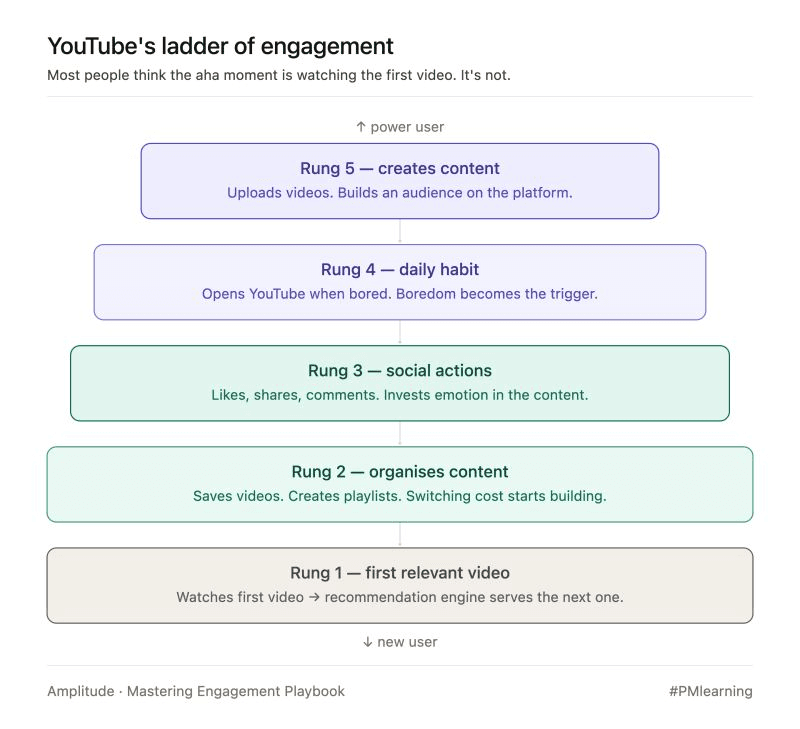
Most people think YouTube's aha moment is watching the very first video. It's not. It's getting recommended the right one after that.
Retention Is a Ladder, Not a Moment
Retention is often treated as the natural outcome of a single aha moment. It isn't — it's a series of small nudges that move a user from "this is useful" to "I can't stop using this," usually called the Ladder of Engagement. For YouTube, the rungs look roughly like this: watch the first relevant video and get recommended another; save videos and build playlists, which is where switching cost starts to build; like, share and comment, investing emotion in the content itself; open the app daily until boredom itself becomes the trigger; eventually, create content of your own and start building an audience on the platform rather than only consuming from it.
Each Rung Raises the Switching Cost
By the fourth rung, YouTube has colonised a behavior that already existed — checking an app out of boredom is not something YouTube invented, it's something YouTube attached itself to. By the fifth rung, the user isn't just consuming the platform anymore; they're building on it, which makes leaving categorically harder than at any earlier rung.
The Hardest Transition Isn't Three to Five
Most feature investment in a platform like this goes toward the higher rungs — better playlist tools, better creator tools, better social features. But the insight that actually matters is which transition is hardest, and it isn't three to five. It's zero to one. If the recommendation engine serves an irrelevant first video, the user leaves and never comes back — and the entire ladder collapses at rung one before any of the later rungs get a chance to matter at all.
Design for Rung One. The Rest Follows.
Which means the single biggest engineering bet a platform like this can make isn't power-user features at all. It's making sure the very first experience feels personal enough to earn a second visit. Everything above rung one is optimization on a foundation that either exists or doesn't — and if it doesn't, no amount of investment in rungs three through five will matter, because the user who needed rung one never made it far enough to see them.
“The hardest transition isn't rung three to five. It's zero to one.”