AI FEATURES DON'T PASS OR FAIL. THEY SCORE.
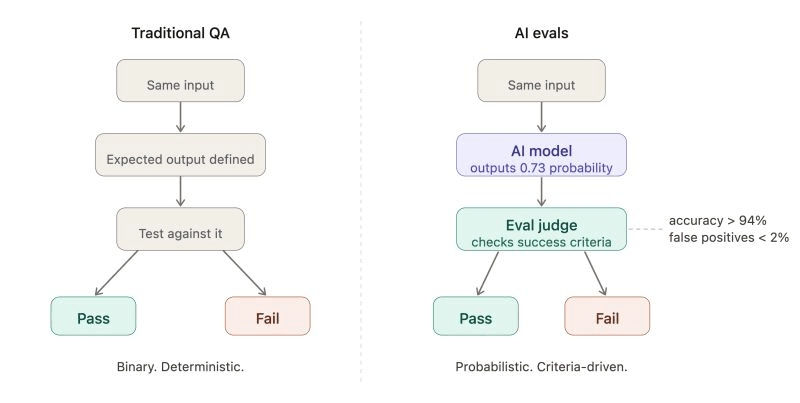
Razorpay's fraud detection model doesn't tell you whether a transaction is fraudulent. It tells you there's a 0.73 probability that it is. What happens next — block it, flag it, let it through — is a decision someone has to make about that number, and it isn't obvious.
Where You Draw the Line Is the Product
Block everything above a 0.6 probability, and you kill a meaningful number of legitimate transactions along with the fraudulent ones. Wait for 0.9 before acting, and real fraud slips through in the gap. Neither threshold is objectively correct — the choice trades false positives against false negatives, and that trade-off is a product decision, not an engineering one. It just happens to be expressed as a number instead of a feature spec.
Why Traditional QA Breaks Here
In normal software, testing is binary: same input, same output, every time. You define expected behavior, test against it, and ship — pass or fail, deterministic. AI products don't offer that. The same input can produce different outputs. Models drift over time as data shifts underneath them. Edge cases multiply faster than anyone can enumerate them. There is no single "expected output" to test against, which means the entire pass/fail mental model traditional QA is built on simply doesn't apply.
What Evals Actually Are
This is where evals come in. Evals are how AI product managers define and measure success for probabilistic systems — instead of asking "did the feature work?", the question becomes "did the output meet the criteria we set?" For Razorpay's fraud model, that might look like two concrete acceptance criteria: flag accuracy above 98% on high-value transactions, and false positives held below 2%. These read like requirements, but they're actually acceptance criteria for a system making real decisions, on your behalf, at scale, in real time, with no human in the loop to catch a bad call before it happens.
The Threshold Is the Actual Product
That's the part easy to miss: the number where you set the line isn't a config value tucked away in a settings file. It's as much a part of the product as any screen a user ever sees — it just doesn't show up in a screenshot.
Prompts make headlines. Evals decide whether your product lives or dies.
“Prompts make headlines. Evals decide whether your product lives or dies.”