WHAT'S THE SHELF LIFE OF A HEALTH ASSISTANT'S KNOWLEDGE?
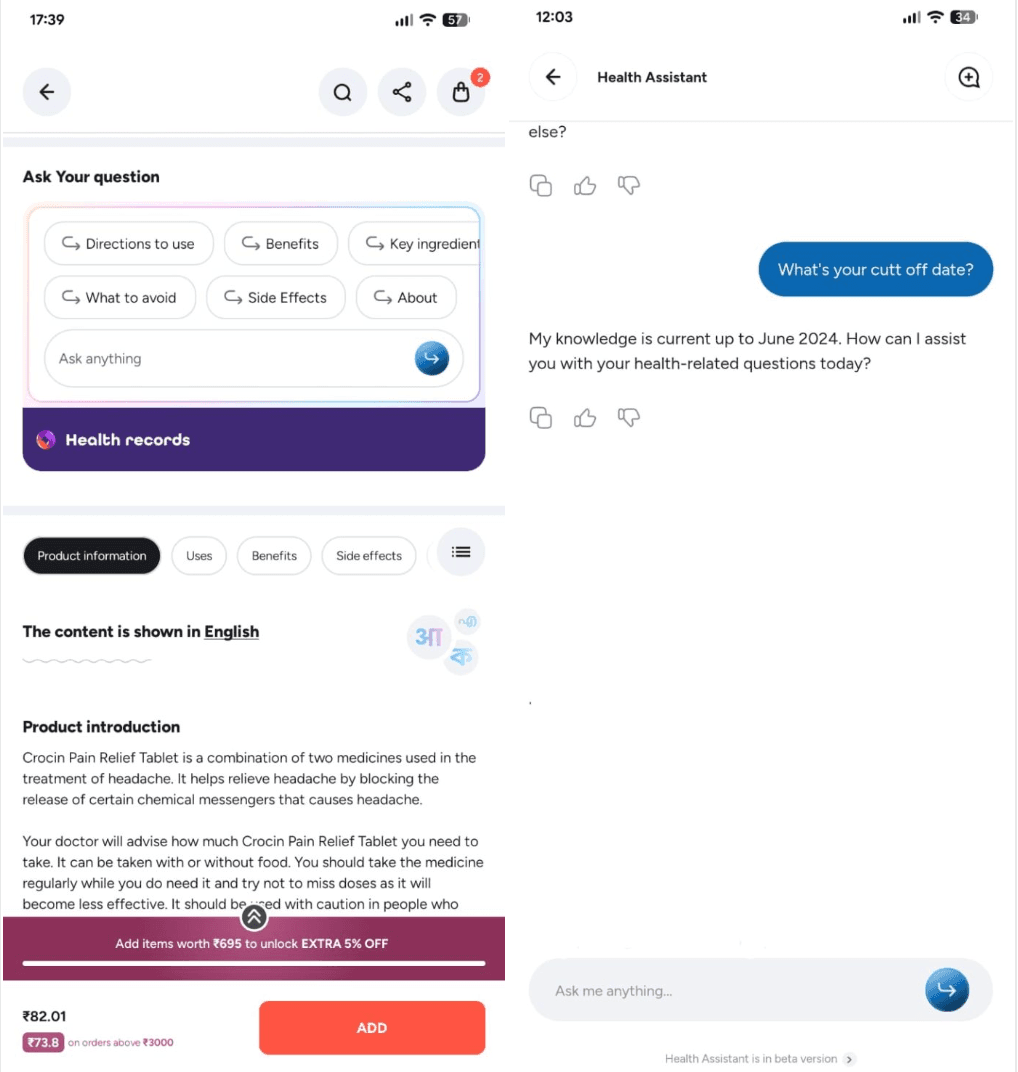
I explored Tata 1mg's Health Assistant last weekend. Solid UX, thoughtful design, a clear intent to help users make better health decisions — the entry point sits right inside the product page, with quick-tap prompts for directions to use, benefits, side effects, and a free-text "ask anything" box. Then I asked it a direct question.
The Question That Exposed the Gap
"What's your cutoff date?" The assistant answered without hesitation: its knowledge is current up to June 2024. For a general-purpose chat feature that's a footnote. For a health assistant sitting on top of medicine detail pages — the same pages showing dosage instructions, drug interactions, and what to avoid — that's not a footnote. It's the whole product.
Why a Frozen Cutoff Matters More in Health Than Anywhere Else
Drug interaction guidelines get updated. Medicines get contradicted. Dosage recommendations get revised — sometimes based on new trial data, sometimes based on regulatory action. None of that reaches a model whose knowledge was frozen at a fixed point in time. This isn't a design problem. It's an architecture problem: AI models are trained on a fixed dataset, and everything the model knows is locked in at that point, permanently, unless something changes how it retrieves information at answer-time. For a customer support bot answering questions about shipping and returns, that's an acceptable trade-off. For a health assistant, it's a risk quietly baked into the product.
What RAG Actually Changes
This is where Retrieval-Augmented Generation matters. RAG keeps an assistant current by pulling fresh guidelines, updated interactions, and new approvals into its answer at the moment of the question, without retraining the underlying model from scratch. The model doesn't need to know everything. It needs to know where to look — and that distinction is the entire architecture decision in one sentence.
Testing the Assumption With the Team Itself
I raised this directly with the Tata 1mg team, and their response was worth taking seriously:
"Thanks for flagging this, Akash. That cutoff date refers to the underlying model's training data, not the freshness of the information the assistant actually uses — it draws on multiple inputs beyond the base model. You're right that we shouldn't be surfacing that detail in the experience, and we'll fix it. We're still in beta and improving."
That's a real distinction worth sitting with: the model's training cutoff and the assistant's actual knowledge freshness aren't necessarily the same thing if retrieval is already wired in behind the scenes. But the experience didn't communicate that — a user asking a direct question got a direct, alarming answer, and that's exactly what caught my attention as a user in the first place. The team agreed, and confirmed they were already working on it.
The Real Decision Was Never Technical
The decision of whether to lean on RAG, or otherwise keep an assistant's knowledge current, isn't really an engineering call. It's a product call — one that defines how much you're willing to let users trust what your own assistant tells them. Great UX sitting on top of frozen knowledge isn't an accident. It's a product decision someone made, knowingly or not, and the fact that 1mg is still in beta means there's real room to make that decision deliberately before it scales.
“The decision of whether to use RAG isn't an engineering call. It's a product call — one that defines how much you trust your own assistant.”